

 The assassination of Charlie Kirk on 10th September 2025 sent shock waves around Christianity and the world.
He was a 31-year-old Christian who made a legendary stand for his faith through his main ministry, Turning Point USA, and influence in both political and religious spheres, working closely with leaders such as Donald Trump.
There’s a whole range of views on Charlie and his stance on various issues, but there’s one that really stands out for me, and that’s his position on a weekly Sabbath day of rest.
Over the previous few years, he had started observing this on the ‘original’ seventh day of every week, a Saturday.
This is more familiar amongst the Jewish community rather than mainstream Christianity, which either doesn’t believe any such obligation now exists after Christ's resurrection, or it has changed to a first-day Sunday if it is believed it still does.
He genuinely believed and practised this after having a personal understanding and revelation of it. This is also my own experience, you can read about here, and another in-depth piece here on why I believe the seventh-day Sabbath remains applicable as a weekly day of rest for Christians today.
Charlie Kirk’s view on the Sabbath rest
I’ve therefore summarised seven key aspects about this Sabbath rest that Charlie has actually spoken about before his death (and a meaningful number seven when considering the seventh-day issue here).
These are direct statements I've found online that Charlie made on the subject while he was alive, rather than other interpretations. I’ve transcribed what Charlie said on each point as a quote, along with a link to the relevant videos at that point (stated in hours, minutes, and seconds).
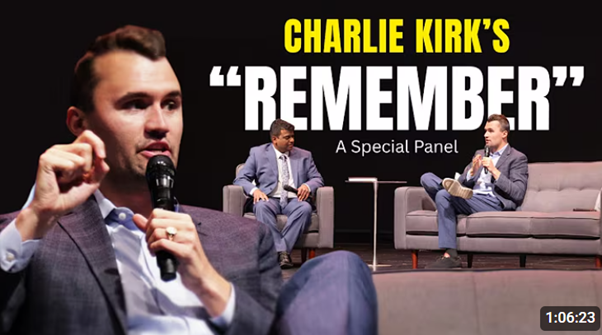
The total video footage is over 7,000 words over a dozen clips, the main one being over an hour long, from the ‘Remember’ conference in March 2025 with several other people with Charlie at different points. This is the main one referred to and I've listed all these at the end of this post (and will also keep updated with any additional content that I come across).
As a summary, Charlie describes the Sabbath as:
"A topic that is near and dear to my heart, the Sabbath commandment" (1: 0:06-0:11)
"The Sabbath is one of my favourite topics to talk about, honestly, 'cause I'm so sick of talking about politics all day long" (1: 4:36-4:43)
He’d actually written a book on the subject called Stop, in the Name of God: Why Honoring the Sabbath Will Transform Your Life, which is now published and I've done a post and review about here.
I've also added to this book post any related quotes and feedback from others close to Charlie, like his wife and his ministry, as I want to keep this post just on what Charlie actually said on the subject himself.
Therefore, here are the seven core aspects of the weekly Sabbath rest that Charlie spoke directly about:
1. His personal testimony of the Sabbath
This is clearly dear to Charlie, as he says it is one of his favourite topics to talk about as above, more so than even politics, which he’s probably most known for.
But he goes further, to how this literally helped save his life and preserve his family and career. He’s seriously busy with work and life, and therefore discovering the need and enjoyment of one day a week’s rest had evidently brought balance back into his life.
“And it's honestly how the Sabbath saved my life and helped preserve my family and help preserve my career.” (1: 5:50-5:58)
One of the ways he discovered this was in 2021, when he was speaking with Pastor David Englehart, who is also on the board of Charlie's organisation, Turning Point. Charlie was feeling fatigued and even exhausted, and David asked if he had been observing the Sabbath rest.
At this point, it was a resounding no, and various poor attempts were made to justify why he thought this was no longer applicable for Christians today.
“A pastor that I really care about, pastor David Englehart. He's one of our board members at Turning Point USA. I was exhausted; it was the summer of 2021. I sat down with him, I said, I'm not sleeping well. I'm fatigued. And he asked me very bluntly, are you honouring the Sabbath? And I gave him very weak theological arguments, honestly. Oh, I'm not bound to that or no, I'm not really interested in that. I don't have to do that. And he really challenged me, and I didn't have good responses to be perfectly honest with you.” (1: 6:00 - 6:30)
He also mentions a good Jewish friend, Dennis Prager. He recommends his resources on the topic, as well as the influence of many Orthodox Jews who observe the Saturday seventh-day Sabbath and have been a positive influence on Charlie.
“My very good friend who is Jewish, who right now is going through a very difficult health trial, Dennis Prager, who I believe is the premier Torah teacher of this generation. He's amazing. He's a phenomenal mind. And if you don't know Dennis Prager on the Sabbath, you guys would really appreciate Dennis Prager because he has brought the teachings of the Sabbath to more millions of people than almost anybody alive. And I hope to carry that tradition. And he would always talk about the Shabbat, always talking about the Sabbath. And I found myself after a couple of years of hearing this, getting really jealous of him. Being like, wait a second. You're able to just unplug for one day and not work and be with friends and family and worship God. I want that. And I would start to get really jealous in the worst possible way. And then I realised it's not something you go and purchase at the store. It's not something that you have to take out a loan for. It's simply the prioritisation of the question of who's in charge. It's that simple.” (1: 6:30 - 7:32)
Therefore, there was something he almost envied about people being able to truly rest and switch off for one day a week and enjoy this time away from the busyness of life. When he eventually tried it, he then immediately recognised the importance and blessing of this.
A couple of other points he highlights from personally observing the Sabbath, is that firstly it is important to specifically choose to observe the Sabbath fully (although there can be things that crop up).
“I could talk about this all day long. I do want to emphasise one thing, because I love that, because sometimes I have to break the Sabbath, and it's hard. We're doing an event or a conference or it's tough. I mean, you know what that's like, where if people are counting on my appearance, that's where it gets very difficult, because then I don't want to lie, I don't want to mislead.” – (1: 1:03:15 - 1:03:38)
And secondly, how its a wonderful and relaxing expression that's actually hard to come back out of and begin ‘normal’ life again, so much so that even though it technically ends on a Saturday evening with the original Sabbath running from sunset on Friday evening to sunset on Saturday evening, he often continues until Sunday morning to before he even puts his phone back on.
"I go even all the way to Sunday morning because it's just too nice. As you know, on Sabbath night, I want to, I want to glide that all the way down to Sunday morning. You know what I mean? And I'm trying to just stretch it out as long as I can. And that's very important" - (1: 15:22-16:23)
2. What the Sabbath meant to Charlie and how he observed it
Getting more practical, Charlie quite rightly saw the core issue of the Sabbath as being about stopping. To cease from work and daily routines of life, and to rest, using this set-aside time to focus more on God.
He highlighted that the original word ‘Shabbat’ means ‘stop’ and ‘cease’, and that it is something you need to prioritise and choose.
He evidently took this seriously and literally turned his mobile phone off at the start of the Sabbath, and didn’t turn it back on or engage in any digital communication until after it had finished. He highly recommends this to others as well, and how the Sabbath ‘detoxes’ you from it, and how people should try it and experience it directly.
“So one very easy way, and the science shows this is that I turn off my phone for from Friday night to Sunday morning... And because when I hear that someone is honoring the Sabbath and they still have their phone on, I'm like, at least for me, my phone is a portal to work first and foremost, and it might be 1% family. And you know what? I mean, I have 1,500 employees. We do a lot. And so even if it's on Saturday or constantly ask me about certain stuff. So for me, my stress goes down significantly. What I even find everybody is that when you turn off your phone on Friday night, by Saturday afternoon, your habits slightly start to change where you don't miss the phone as much. You're not like reaching for it all the time.” – (1: 15:29-15:44)
Charlie also stops any worldly secular sources of content:
“So, I will not watch the news. I will not read a newspaper. I will not have my phone on.” – (1: 16:49-16:55)
He humbly highlights the cost of not answering his phone on the Sabbath, managing over 1,500 employees, and literally not answering calls from the President of the United States.
“And I will say this as, and I hope you'll understand my heart when I say this as humbly as I possibly can. If I can turn off my phone and honor the Sabbath, you have no excuse. I'll just be very honest with you. Okay? Because I've missed some very big phone calls before. And let me just be very honest. I've missed phone calls from the president of the United States, but God told me to not work that day. And so, by the way, you can always call people back” – (1: 17:24-17:51)
And that last statement from Charlie summarises it nicely – Charlie observes the Sabbath because God told Him to, no matter what anyone says.
He then goes on to say that he uses this time for God rather than just being idle. Plus, at one point says that if someone comes to your home while you are observing the Sabbath rest, and they don’t see you doing anything different from the other six days of the week, then you’re not doing this correctly.
“Are you ready for the Sabbath test? The Sabbath test is this. If I cannot walk into your home and tell that it's the Sabbath because it looks like every other day, you're not honoring the Sabbath. If it looks like every other day, then you aren't dedicating one day to God.” – (8)
Charlie then emphasised the importance of being with his wife and family at home, and how they would experience this Godly rest together, having time to read the Bible, pray, and take walks. This all helped bring back a natural rhythm to life.
“We get to spend more time with our family. We do no news. We do no work. And it says very, very clearly in the scriptures for six days, you shall work. And the seventh day you shall rest. If you are feeling overrun by society, you might be feeling depressed or anxious. Here's this one way that you might be able to improve. Turn your phone off for one day. No contact, no social media, no work. Your mental health will improve dramatically. You can, you can hang out with friends. You can go for a walk, but don't work for one day. That is a day for worship. That is a day for the Lord. That is a day to go be with God. That is a day to read your Bible and be out of the busyness and the hurriedness and just the anger and the noise of this world. Go back to God's natural rhythm and it's made our family much tighter knit. And I could be traveling for five or six days, but if I at least got one good Sabbath with my family, it charges all back up” – (6)
He mentions his interest in College Football which he does watch on the Sabbath, specifically because to him it is relaxing and enjoyable.
“I will, however, watch college football, which some people say, well, that's not a Sabbath. It's highly enjoyable for me because it's not work and it's connecting. I watch with my family. I enjoy it because it says for six days, you shall work and on the seventh day you shall rest” – (1: 16:55-17:10)
There are then tangible health benefits he experienced from following the Sabbath:
“I found my stress markers went down dramatically. My health improved. I lost a lot of weight, my energy, my vitality.” – (1: 17-16-17:23)
Plus, his wife Erika, in one interview, echoes that Charlie was more relaxed and engaged on a Sabbath day of rest (7)
As mentioned earlier, Charlie also emphasises how observing the Sabbath is a choice – something that we decide to do to honour God and which we’re actually tangibly blessed by, even though sometimes our carnal selves may fight against this:
“And my goodness, does our flesh not want to do that? Your flesh fights this idea like, oh, I'll do a two-hour Sabbath this week, or I'll just do a little bit of work. That is your flesh. That is the enemy. If it was easy to honor the Sabbath, then God would not have to command it time and time again. Hey, remember it guys, remember it. Because the way that in our depraved nature, the enemy wants to prioritize materialism over our creator. Prioritize your own fleshly pursuits over the elevation of the divine.” – (1: 25:48-26:23)
3. His explanation of why Christians should still observe the Sabbath
At one point, Charlie boils down a key verse to determine whether one should follow the Sabbath or not, right at the start of the Bible, in Genesis 1:1 (“In the beginning God created the heaven and the earth”).
“And if you believe God is in charge, and if you believe Genesis 1.1, because the Shabbat is a question of whether or not you believe Genesis 1.1. And if you believe Genesis 1.1, then you honor the Sabbath. If you have questions about Genesis 1.1, in the beginning God created the heavens and the earth with his might, right? It's the first truth claim of the scriptures. Then on the seventh day, you rest because God created the heavens and the earth. It is the longest standing celebration of time of the creation of the heavens and the earth.” – (1: 7:30 - 8:01)
This sets the scene with God creating the world; therefore, logically, we should follow what He has created, including the seventh day of rest which He made at the end of the creation process.
He says this shows us who’s in charge – God, rather than ourselves. Also, it is God Himself whom we worship who made creation and the Sabbath, not creation itself.
“And the final thing I'll say is this is in the book of Romans. In Romans I, this is very important. We must never worship creation, and it warns us about this. And you see this with people that will worship nature or worship the sun. We are to worship the creator and Shabbat gives us that opportunity to then worship the creator of the heavens and earth. “ (1: 23:46 - 24:10)
Another point mentioned is the question of why God rested on the seventh day. After all, God, being the all-powerful one, of course, doesn’t need rest, but instead will have experienced a deeper wonder and appreciation of what He has just made.
He clearly links this to the experience of Christians today under a New Covenant and how this ultimate rest is now ‘in Christ’ Himself (and therefore how this Sabbath day is an expression of this)
“Well, in Jesus, we find our rest. And that's the critical thing is that we're promised that the Sabbath will give, we should find rest in the Sabbath. And on the seventh day, God rested and saw that it was good. But we know that our ultimate rest is in Christ Jesus.” – (1: 21:23 - 21:42)
Charlie later outlines how there is a modern tendency to assume that Christ was (and is) against the Sabbath, which is not the case:
“But there, I think is some sloppy and misleading Christian teaching at times that says that Jesus does not want you to honor the Sabbath and Jesus broke the Sabbath. I'm not going to get too far deep into that. I'll allow my new friend to comment on that. But here's what I will say is that we believe in a triune God and therefore that it predated the law and creation was mentioned by Christ several times and emphasized all throughout scriptures. In fact, I believe that there are miracles all throughout the Bible, but the two miracles that we as Christians must remember on a daily and weekly basis is the creation of the world and the resurrection of Jesus Christ.” – (1: 21:49 - 22:33)
At one point, He links Sabbath keeping to the simplicity of loving God and our neighbours as ourselves:
"Jesus said upon all of the laws of the commandments, these two hold - love the Lord, your God, all their heart, soul, strength, and mind, right? Deuteronomy six. And then Leviticus 19, love your neighbours as yourself. How are we supposed to love our God with our heart, soul, strength, and mind? Well, you think about it. What makes the Sabbath so unique is that it is a cathedral built in time. Is that it is part of your schedule that you are dedicating to the Lord.” (1: 25:19 - 25:48)
He therefore emphasises how the Sabbath day is a gift for us all to enjoy, which aligns with how God is said to bless and sanctify this initial seventh day of rest (and not the other days). It wasn’t just a gift to the Jews later on in the Ten Commandments; it was meant for everyone, and if you don’t observe it, then you’re missing out on something good and enjoyable.
On the subject of the Ten Commandments, Charlie mentions that he thinks this is the most overlooked commandment in the Decalogue among Christians, to our detriment, and that the enemy has weakened it, causing Christians to ignore this.
He therefore views these as God’s core moral laws, which remain applicable today in the New Covenant.
He goes further to say that you can’t truly fulfil all other nine commandments without first following this fourth one to observe the Sabbath day (and therefore in that sense the most important one that is ironically not followed by Christians today).
“I believe this is the most ignored commandment of the Decalogue to our own detriment, which is that I believe that honoring the Sabbath is the commandment that allows you to honor the other nine commandments and that the enemy has gone after the honoring the Sabbath because then it is easier to weaken the other nine. And I'll prove it to you. If you're honoring the Sabbath, it's definitionally easier to honor your mother and father because you're not working that day and you're with family. If you're honoring the Sabbath, it's easier not to covet your neighbor's wife because you're not around your neighbor's wife. You're with your family and you're filled with gratitude that day. When you're honoring the Sabbath, it's easier to have no other Gods before God because that day is built in time as a temple, as a sanctuary to put God first, to not have idols, to not take the Lord's name in vain. The other nine commandments are made easier, are made more accessible for our broken, fleshly, depraved nature if we prioritise the Shabbat.” (1: 8:22 - 9:28)
Charlie makes a great point about the two points when the Ten Commandments are described in the Old Testament. The first is in Exodus 20:8-11, when they were first given, and the second is in Deuteronomy 5:12-15, when Moses reflects on these afterwards.
In this second edition, the reason for the Sabbath commandment is rest from slavery in Egypt, not just a remembrance of God's creation as in the first one, which ties to the point that the Sabbath provides us with freedom from the slavery we feel in modern life and society.
“So of course, the 10 commandments is repeated in the book of Deuteronomy. So, it's Exodus 20 and also the book of Deuteronomy. They're identical, except for what... do you know what the difference is? It's okay. I don't have to put you on the spot. It's okay. It's really important. Does anyone know? The Sabbath, do you guys know the difference? It's... the only difference, the only difference, everything identical is that Moses says honor the Shabbat and it goes on because you are no longer slaves like you were in Egypt. Only slaves work all seven days, everybody. It is a commandment that keeps you free.” (1: 33:50 - 34:23)
In one interview, when he’s responding to someone else saying that the Christian church has removed the Ten Commandments from their midst, he assuredly responds:
“I completely agree. And it's a tragedy. And I think it's against God's commands and his wish for his church.” (1:27:37 - 27:42)
Regarding modern New Testament times, he alludes to the debate about whether this Old Testament law still binds Christians today. In one interview, he says this is not necessarily a biblical command to observe it, although in another, that Christians are still 'bound' by it.
“So as a non theologian, it's a great question or a non pastor. I'll respond - while I do believe we are bound by the Sabbath, I'm not properly equipped or it's my profession to get into theological debate” (1:24:33 - 24:44)
He steers actually way from deep, and logical arguments here and instead offers a more straightforward explanation, one he clearly believes applies to Christians today. However, there is one good point he makes about whether Christians should still observe the Sabbath day, without getting into the complex world of theology. That’s a plain question to people about if God would approve or not.
“I will say, do you believe that given the option, this is my best answer because this is how I think. Do you think that God would prefer you to turn off all your devices and stop working and worshiping him for 24 hours with your family or running around town, going to bars, doing slot, you know, just continuing in corporate work, which do you think is more Godly?” (1: 24:47 - 25:11)
4. How Charlie saw the seventh-day Saturday (not Sunday) as the day to rest
Charlie views the seventh day of the week as the right day for a weekly rest, which falls on a Saturday. This is what the Jewish faith still observes, was definitely practised in the Old Testament, and which has clearly influenced Charlie.
“We actually take the traditional Jewish Sabbath. If you don't want to do that, I'm not here to debate you on it. It's fine.” – (6)
He still believes this is the right day now as a born-again Christian under the New Covenant of Christ, something I agree with and have experienced myself you can read about here.
Although, of course, modern Christianity and church life takes Sunday as a weekly day of rest (or a convenient day to meet if believers assume no weekly rest day is now necessary), which Charlie is sympathetic with and is clearly involved in churches and ministries that gather on Sunday.
However, he points out that he continually warned such church leaders that they were still ignoring this core command to observe the Sabbath rest (described below).
5. His reference to churches and the Sabbath day
Building on the last point, Charlie briefly notes the principle of whether a weekly day of rest is observed in actual churches and denominations.
He explains his own background and how he saw himself as a regular church attendee himself, although also with, of course, a very influential worldwide Christian ministry. He explains his own church background as:
“I grew up in a Presbyterian background. I then... we left that church. We went to what could be best called as a Bible believing evangelical church. So not quite Calvinist, not Pentecostal, somewhere in the middle...I grew up in a church environment that at the very best would deemphasize the Shabbat at the very worst to say that the Sabbath doesn't really matter. The Sabbath is in your heart. You don't need to observe it.” – (1: 4:53 - 5:34)
“I am instead, in my role in life, I am a Bible believing church attending Christian that talks about Jesus every day. I am more interested in the moral, at least in my career, the moral application of God's teachings.” – (1: 26:30 - 26:42)
However, as mentioned above, he’s now always challenging churches to take this weekly day of rest seriously.
“I also go to churches across the country. I speak at hundreds of churches of all different denominations and I will challenge the Christian church because I believe this is the most ignored commandment of the Decalogue to our own detriment” – (1: 8:11 - 8:28)
Regarding specific church denominations, he does refer to the Seventh-day Adventist Church, which is undoubtedly the main one that still observes the seventh day, Saturday, as a day of Sabbath rest (the most extensive interview with him online about the Sabbath comes from a conference organised by people from the Seventh-day Adventist church).
He’s evidently new to the denomination, as he asks in one interview whether they have issues such as overworked women and pastors on the Sabbath, as he’s seen in the Jewish Community observing Shabbat and the ‘Shabbat Problem’ where they end up ‘working’ to help themselves prepare meals and to teach/minister (1:46:37 - 47:06& 47:15 - 47:47).
He also highlights that the quality and length of life of members in this denomination are statistically better than those of members of other denominations.
“People that honor the Sabbath live longer. We know this of the Seventh-day Adventists. They actually are happier. They have better health outcomes.” – (4:4:27 - 4:34)
I can also relate to Charlie on this, as I now fellowship at a Seventh-day Adventist church (there are other unique doctrinal issues to be aware of, including how they see this Sabbath issue being the key issue of the seal of God against the mark of the beast at the end of time).
6. His emphasis on working the other six days of the week
A great point he also makes is that, in contrast to the one day of rest; the other six days of the week should be days of work. He explains that he himself has a chaotic work schedule with endless responsibilities and issues, which is why he needs to practically turn his phone off on the Sabbath to avoid getting involved with them.
However, he says the other six days are meant to have hard, meaningful work, including Sundays, rather than the assumed five weekdays of work and a whole weekend of leisure.
He goes further to say that the Sabbath then helps focus and energise the other six – it's the day that you end up longing for during the busy week, and are refreshed from afterwards to launch into the next six days of activity, which are then more productive than if you’d not taken a Sabbath rest.
“But remember that the commandment, as much as it is to honor the Sabbath, is that for six days you shall work. It's also a commandment to work and to be fruitful and multiply the other six days. What I have found is that it creates healthy urgency. Those other six days to be more productive because there is an end in sight. Whereas it's not just the cyclical motion, you know, perpetual motion machine of seven days of work and no respite. But God wants us to work. And that is what's critically important, is that if you shall not work, you shall not eat. The scriptures say that it doesn't want you to rest for seven days and vacations are fine and all of that. But to work for God's purposes is an equal part of that commandment that is sometimes missed” – (1: 1:3:37 - 1:4:25)
As mentioned earlier, he mentions how he doesn’t rush to automatically get back into work mode at the end of the Sabbath on Saturday night.
7. Highlighting the broader benefits to life and society
A final point he raises is the broader benefits of a weekly Sabbath rest for others and society as a whole. Although he doesn’t go into much detail, probably because of his automatic involvement in the political arena and wanting to keep focused on this issue, he still does mention.
For example, how people’s health and well-being are affected by not having a weekly day of rest that God made us to enjoy. This, in turn, leads to various medical and social issues, particularly in an increasingly busy and technologically focused society.
Additionally, taking this day seriously on a broader society level will enhance the well-being of the whole of society.
He also commented on how individuals respond to him taking the Sabbath who are not Christian believers, which I totally agree with and have found a better response from than Christians, unfortunately.
There is a point mentioned earlier about how Charlie emphasised the fact that a weekly Sabbath rest will free us from the demands of modern life, linked back to the Israelites' slavery in Egypt. He develops this further into a ‘macro’ level and society as a whole, not just Christians, and how free people need to honour the Sabbath.
“This is the more macro point and I just want to say what Moses was saying in the book of Deuteronomy is that if you want to be a free people, you must honor the Sabbath. I will go a step further. You cannot have a free society if you're working for seven days a week. You will be a slave to something and the worst possible.” – (1: 36:07 - 36:30)
He also refers to the research into those who observe the Sabbath generally living longer and healthier than those who don’t.
“I'm actually looking for it for my book that, but there has been some studies, Shabbat observers live longer, they're happier, they're less likely to be depressed. They're on less antidepressants. They just are... they have a much more enriched, they're more present there. And I want to reemphasize something I said prior, which is we are living in a hyper sick society. Our kids are sick. Half of our kids are on antidepressants by the time they reach 18. These screens are just destroying and frying our kids brains. And here we have, there's a whole chapter in my book dedicated to this. Here we have this ancient gift waiting for us and it doesn't require mapping the human genome of which I agree with everything the doctor said. It just is, just honor God's commands.” – (1: 45:15 - 46:01)
Plus, one surprising fact he highlights is that on the Sabbath of the Ten Commandments, this is actually the first time that even animals are to rest rather than being used all the time for human purposes.
“Animals make an appearance in the 10 commandments. Because they get a Shabbat. Yes.... It is the first time in the ancient world that there's a recognition from the almighty that animals are not simply just to be used all the time for your purpose, that they're not the same as human beings, but they deserve a time of rest... It's a beautiful teaching that animals are not made in the image of God, but they are created and that they should not be abused and they should also be given rest. I think that's a lesser appreciated beauty of the 10 commandments.” – (1: 48:55 - 49:29)
Charlie Kirk’s take on the seventh-day Sabbath rest for the Christian
These seven points hopefully give you a good overview of Charlie’s position on the subject, something I personally wholeheartedly believe in. You can check out details and a review here about his book on the subject - Stop, in the Name of God: Why Honoring the Sabbath Will Transform Your Life.
I also have a piece here explaining the whole subject in a lot of detail and how I believe that still applicable for Christians, which boils down to three reasons:
1. God created the Sabbath day at creation to last forever (and therefore not changed)
2. God blessed this day and made it special (with no evidence of it being in any way unblessed and changed)
3. God commanded this to be observed in the Ten Commandments, which is still applicable as the core moral law under the New Covenant of Grace through faith in Christ.
As Charlie highlighted himself a few times, it’s essential to explain the importance of the Sabbath rest and what a blessing it actually is (and maybe the key to their re-connection with God):
“My message to churches is you are missing out so sorely by not honoring the Sabbath and my advice to all of you that care about the Sabbath, we need to become better evangelists for the practice of honoring the Sabbath. How it strengthens your marriage, how it deepens your connection to God. And I think for some Christians, not all, that it might be the missing link of what they... you know, they're like, Charlie, I'm going to church, I'm tithing, I'm singing the songs, but there's something missing. And I think it might be not honoring the Sabbath.” – (1: 42:41 - 43:14)
“If you are honoring the Sabbath, talk about it more, talk about it favorably and positively. Try to get, bring the Shabbat to the world.” – (1: 50:37 - 50:45)
In summary, Charlie says:
“If you are currently watching this online and you're not honoring the Shabbat and you are feeling depression and exhaustion and fatigue, there is something that costs you nothing. You don't have to take out a loan. All you have to do is commit to God and to stop what you are doing for one day a week. It will change your life. It will grow you closer to the divine” – (1: 51:11 - 51:31)
References
Here are links to the various online videos of Charlie on the subject and time sections where applicable (the first one is the main one referred to above):
1 - Charlie Kirk’s Final Sabbath Reflections: "Remember" the Sabbath Panel | WYBMW 2025
2 - Charlie Kirk talks the Sabbath
3 - Charlie Kirk’s Death Ignites the Sabbath vs Sunday Debate
4 - Charlie Kirk’s final powerful Sabbath message
5 - Charlie Kirk on honoring the sabbath
6 - Charlie Kirk Sanctified the Sabbath
7 - Charlie Kirk LOVE for Chabad and Shabbos
8 - Charlie Kirk Honored the Sabbath
9 - #Charlie Kirk on the Sabbath
